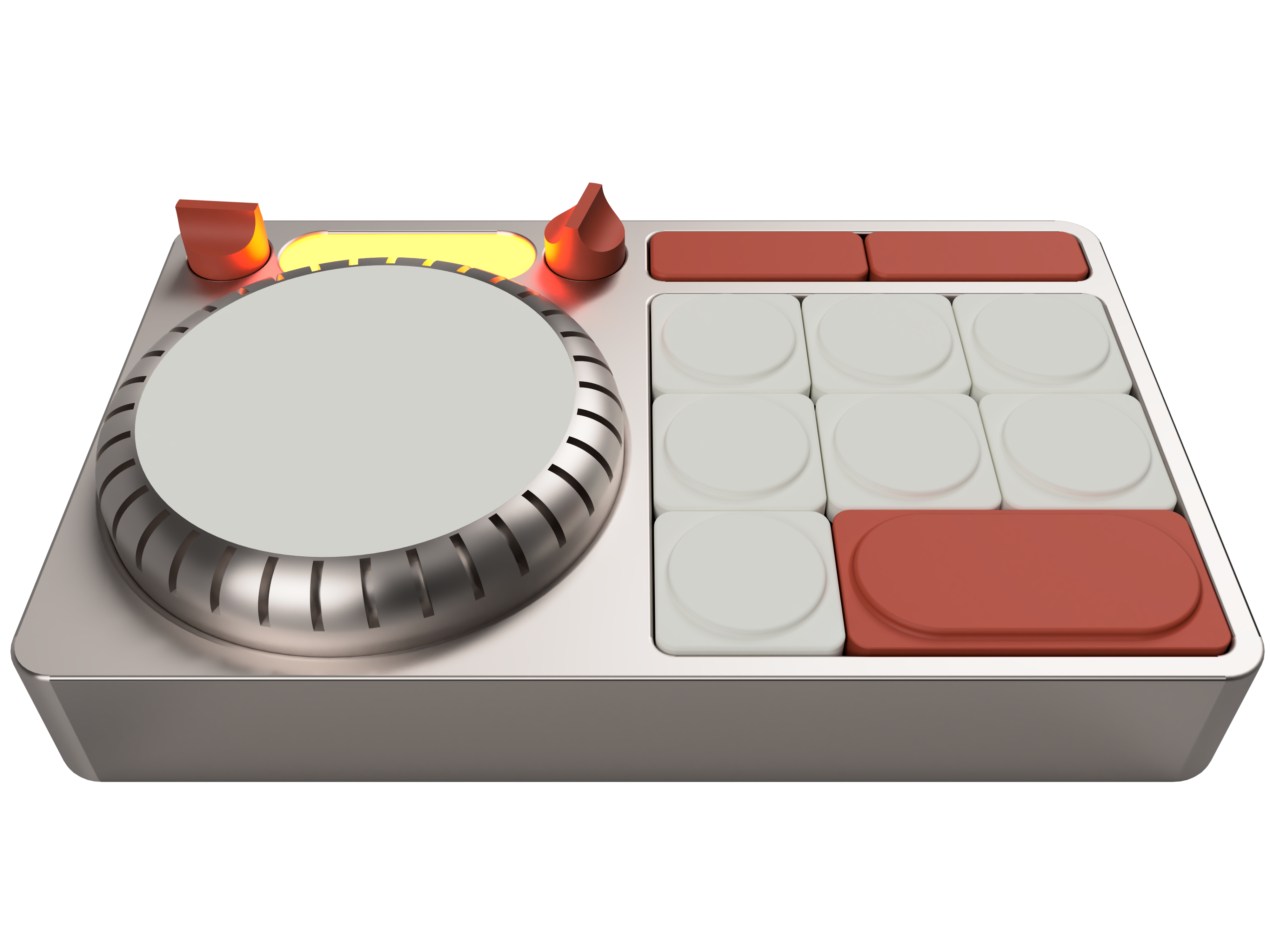
Unplanned downtime costs U.S. manufacturers $50B annually. Most of it goes unlabeled. DIAL is a purpose built operator terminal that captures stop reason codes at the machine in under 5 seconds, gloves on, WiFi optional. Every attributed event becomes structured input for Tractian's OEE engine and a labeled training sample for predictive maintenance models.
Try the interactive demoA CNC machine goes down. The operator has 5 seconds to log a stop reason before walking back to their station. They are wearing thick Kevlar gloves soaked in cutting fluid and metallic dust. The WiFi in this corner of the plant has been down for 40 minutes. Nothing gets logged. The OEE report records "unplanned downtime" with no root cause attribution. The same failure repeats next shift.
Operator attention resets the moment the machine restarts. Any interaction exceeding 5 seconds is consistently abandoned, making input speed a hard design constraint, not a preference.
Capacitive touchscreens fail under gloved input. Thin membrane buttons corrode under cutting fluid exposure. Exposed mechanical components accumulate metallic particulate and seize. Input hardware must be designed for the environment from the ground up.
WiFi outages of 1 to 2 hours are common in heavy manufacturing environments. Cloud dependent solutions lose data silently during these windows. The operator logged the event. The infrastructure did not preserve it.
No two facilities use the same reason code structure. The terminal must support customer defined hierarchies configurable remotely, one hardware SKU deployable across any operation without field modification.
An unattributed stop event does not just represent missing information. It corrupts the Availability component of OEE and removes the signal needed to identify recurring failure patterns at the maintenance level.
Not a repurposed tablet. Not a general purpose HMI panel with downtime logging bolted on. A single function device engineered around the operator's input constraints.
A sealed magnetic rotary encoder for navigation and one oversized confirm button for commitment. The interaction requires no authentication, no mode switching, and no screen management. Two deliberate gestures from stop event to logged record.
IP65 rated enclosure with a non contacting magnetic encoder. No mechanical wear surfaces, no particulate ingress path, rated for mud, dust, grease, and cutting fluid. IP67 pushbuttons at both input points. Rotary shaft seal at the encoder penetration.
The electronics core is a self contained unit. The rubber surround functions as a replaceable protective shell, covering edges and back while leaving the face fully accessible. Field damage to the surround does not require electronics replacement.
Every stop event is committed to NVS flash storage before any network operation is initiated. WiFi connectivity is a synchronization channel, not an operational dependency. The local queue drains to Tractian's MQTT broker in chronological order on reconnection.
Scroll the dial or use arrow keys. OK confirms. BACK steps back. Space wakes the device.
Turn the dial to navigate stop categories and reason codes. Every logged event syncs to the Tractian OEE engine.
The two level stop taxonomy, category then reason code, limits visible options to eight at any point in the flow, keeping selection time predictable regardless of how large the customer's full code set grows.
State: IDLE → SELECT_GROUP. DIAL registers the stop event via machine signal or vibration input. The display activates and presents the top level category list without requiring any operator initiated input. The 30 second timeout window begins immediately.
State: SELECT_GROUP → SELECT_CODE. The operator rotates the encoder to scroll through stop categories: Tooling, Material, Machine, Process, External. Each detent advances one position. Input is reliable under heavy gloves, contaminated hands, or indirect contact. OK confirms.
State: SELECT_CODE → LOGGED. The operator scrolls to the applicable reason code and confirms with OK. The event is written to local flash before any network transmission is attempted. The display presents a logged confirmation and returns to idle within 2 seconds.
If the operator does not complete input within 30 seconds, DIAL automatically commits a UNP-TIM record to local storage. The downtime window and timestamp are preserved for OEE calculation and flagged for supervisor review. No stop event is ever silently discarded.
Each component was selected for a specific engineering reason. Click any component to see the rationale and specifications.
Local persistence is not a fallback. It is the primary write path. Cloud synchronization operates as a background process whenever connectivity is available.
MQTT was chosen over HTTP because it maintains a persistent broker connection, making reconnection after an outage fast and the queue drain immediate. Delivery is set to QoS 1, meaning the broker must acknowledge each event before the device removes it from the local queue. A duplicate event is recoverable. A lost event is not.
Encoder input is debounced at 50ms to prevent phantom ticks from machine vibration. Button input at 20ms. The 30 second timeout auto-commits a UNP-TIM record so no stop window is ever unaccounted for.
Tractian's sensors capture the physical signature of every failure. What they cannot provide is operator attributed causation. DIAL closes that gap. The result is a labeled dataset that makes every Tractian predictive model more accurate over time.